
Homeownership Builds Your Wealth over Time [INFOGRAPHIC]
KCM • February 3, 2023
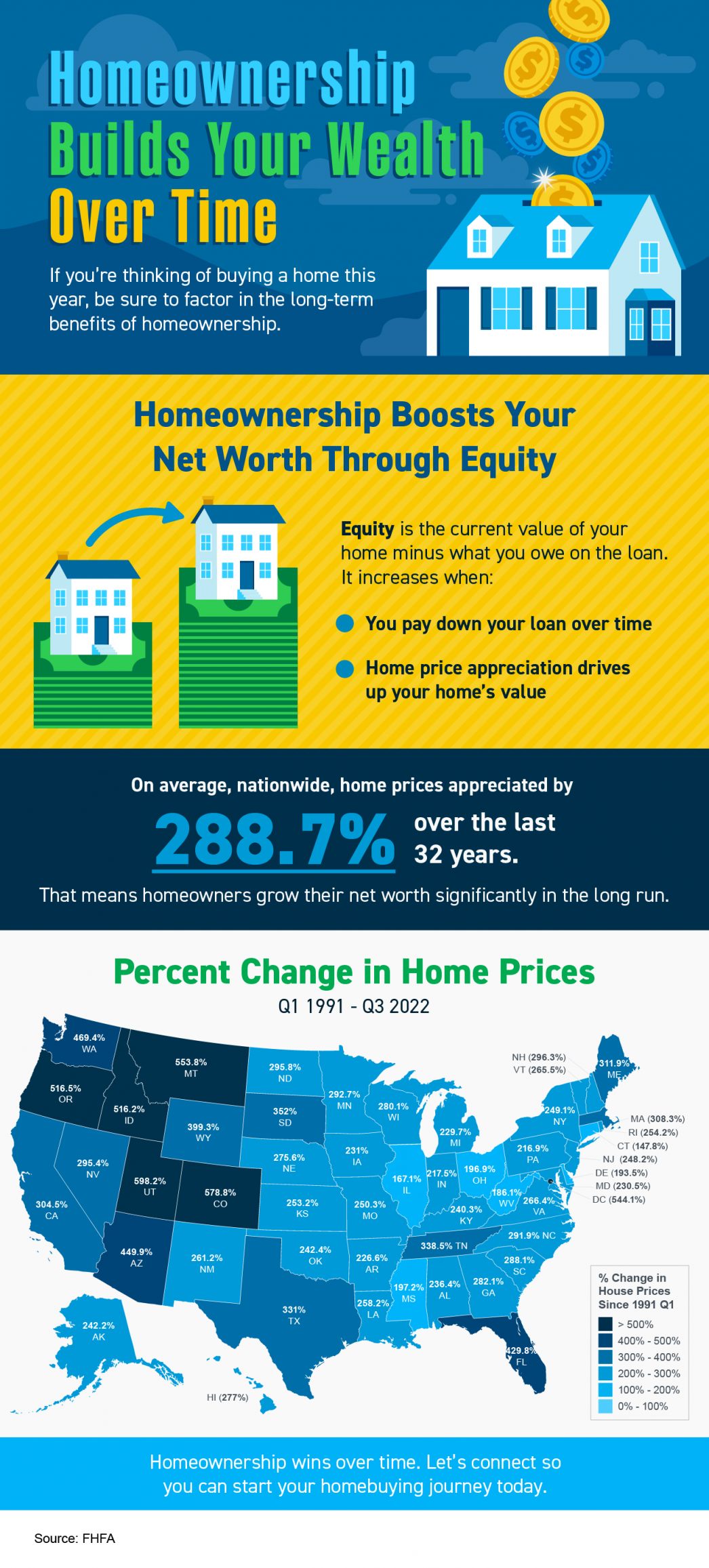
Homeownership Builds Your Wealth over Time [INFOGRAPHIC]
Some Highlights
- If you’re thinking of buying a home this year, be sure to factor in the long-term benefits of homeownership.
- On average, nationwide, home prices appreciated by 288.7% over the last 32 years. That means homeowners grow their net worth significantly in the long term.
- Homeownership wins over time. Let’s connect so you can start your home buying journey today.
Share this post

The body content of your post goes here. To edit this text, click on it and delete this default text and start typing your own or paste your own from a different source.

More Homes, Better Prices: A Buyer’s Summer If you’ve thought about buying a home in the past few years, you may have run into two frustrations: asking prices that kept climbing and too few homes to choose from. In many places, both sticking points are letting up this summer, with lower asking prices and more homes for sale. Let’s look at the trends, and what they mean for your search. Sellers Are Pricing To Attract Buyers According to Realtor.com, the national median asking price was $430,000 in June, nearly $11,000 under what it was the year before (see graph below): That’s the eighth month in a row that the typical asking price has dipped below where they were the previous year, according to the same Realtor.com report. And while falling prices can sound worrying, this isn’t a sign of an impending crash. We’re talking about asking prices, not sold prices. This is a sign that today’s sellers are meeting the market where it is and pricing to draw buyers. And that’s actually something normal we’d expect from the market. As Danielle Hale, Chief Economist at Realtor.com, puts it : “Sellers are reading market conditions and are pricing accordingly from the start rather than listing high and cutting later, and buyers are taking note and making bids. This is a welcome sign that we are in a functioning market. ” Asking prices were never going to climb forever – now they're just settling closer to what buyers can actually pay. That signals a healthier market, and sellers re-adjusting their expectations. More Homes Are Available Now If you’ve spent the past few years watching homes disappear before you could even schedule a tour, this is for you. Supply is starting to catch up. According to Realtor.com, the number of homes listed for sale in June was the highest June number we’ve seen in three years (see graph below): This means more options for you and less competition for each one. Now, supply is not back to normal everywhere. As you can see, we’re still down from where we were back in 2017-2019. But in many places, it’s better than it’s been in a while. Here’s how that helps you. You don’t have to rush an offer just to stay in the running, and you have better odds of finding and landing the right home, not just the one that’s available. Plus, you’ll have more room to negotiate, so you’re searching from a stronger position than buyers had even a year ago. Why This Is Encouraging if You’re Buying Your First Home For first-time buyers looking for lower-priced homes, these trends line up especially well. Mischa Fisher, Chief Economist at Zillow, explains: “The lowest price tiers are exhibiting some softness in terms of price, they also had the most listing-activity growth, the first time since 2022 that’s been the case.” So, if you’re searching for your first place or your next house, there's a little more to choose from and a little more give on price. Bottom Line If a tight budget or a thin selection has kept you from buying a home, now might be the time to restart your search. Ready to see what’s available here? Let’s connect.
Housing affordability has become one of those rare topics almost everyone agrees on: it’s a problem. Buyers feel it, renters feel it even more, homeowners talk about it, and politicians on both sides of the aisle regularly float ideas on how to fix it. Tax credits, zoning changes, interest rate adjustments, down payment assistance programs — for nearly every proposed solution, there’s a counterargument about whether it actually helps or just sounds good on paper. But one idea comes up again and again, across government, finance, real estate, and even everyday conversations among buyers and homeowners: build more homes. At its core, real estate is supply and demand in action. When demand outpaces supply, prices rise. When supply catches up, prices tend to stabilize or fall. So the logic is simple enough. If affordability is the issue, adding more housing inventory should help relieve some of the pressure. Of course, that doesn’t mean it’s easy. Builders aren’t public utilities. They’re private businesses with margins to protect, financing costs to manage, and risk to account for. Construction costs, labor shortages, permitting delays, and interest rates all play a role in whether new homes will actually get built. But with enough incentives and pent-up demand, it’s not unreasonable to think we could see a meaningful wave of new construction in the near future. And if that happens, you might just find yourself excited to go out and look for a new construction home! A Lot of Buyers Casually Walk Into a Model Home for a “Quick Look” For many buyers, the new construction process starts casually. Maybe they drive past a new development and decide to pull in. They walk through a model home “just to look.” They chat with the on-site sales representative — or even the builder directly. It feels low-pressure, informational, and harmless. After all, no one’s signing anything… yet. But what often happens next is where things get complicated. Buyers go home and sleep on it. They come back another time. Maybe even a third. Eventually, it starts to feel real — and that’s when many decide it would be smart to bring in their own real estate agent for guidance, negotiation help, and an extra set of eyes on the contract. Unfortunately, when they try to do that, they often find out it’s already too late to get their own agent involved. Why That First Visit Matters More than Most Buyers Realize What many buyers don’t realize is that the very first visit to a new construction site quietly sets the rules for how the rest of the transaction will unfold. From the builder’s perspective, walking into a model home without an agent isn’t just a casual look, it potentially establishes the buyer as someone working directly with the builder’s sales team. Many builders have clear internal policies that say if a buyer’s first interaction happens without a real estate agent present, that buyer is considered “registered” to the builder. Once that happens, bringing in an outside agent later may not be allowed at all, or may require special approval which can be difficult to obtain. Why? Because builders aim to keep tight control over their sales process. They control the product, the pricing, the incentives, the timelines, and the messaging. Introducing an independent buyer’s agent — especially after conversations, tours, or pricing discussions have already started — adds another voice to the process. And that voice is focused solely on the buyer’s interests. That doesn’t make builders villains. It’s simply how many new construction sales are structured. But it does mean that a decision that feels small in the moment — “Let’s just stop in and take a look” — can have lasting consequences. By the time buyers realize they want professional representation and negotiation help, the window to involve their own agent may already be closed. “Do I Even Need My Own Agent for New Construction?” Some buyers, especially those who like the idea of a streamlined process, question whether bringing their own agent makes sense at all. After all, the builder already has a sales rep. The price is often set. The home is brand new. What’s there to negotiate? It’s a fair question — and one that builders are happy to let buyers ask themselves. But it’s important to remember that the builder’s sales agent works for the builder. Their job is to protect the builder’s timeline, pricing, and contract terms. They are not obligated to point out unfavorable clauses, suggest alternatives, or flag long-term resale considerations. An independent buyer’s agent serves a very different role. Their responsibility is to the buyer — not the builder. That means advising on contract terms, explaining how builder add-ons and incentives actually affect the bottom line, and helping buyers understand where there may be room to negotiate, even when the base price appears “fixed.” In new construction, negotiations often happen in less obvious places. Closing cost credits, upgrade packages, lot premiums, build timelines, contingency language, and even how issues are handled during construction can all have real financial and practical implications. These are details buyers may not think to question, but they can matter long after the excitement of choosing finishes wears off. An experienced agent can also provide context that isn’t available in the model home. How this builder compares to others nearby. How resale values have held up in similar developments. Whether certain upgrades tend to pay off (or not) when it comes time to sell. That kind of perspective doesn’t come from the builder’s sales office, because it doesn’t serve their interests to provide it. In short, new construction may look like a straightforward sales process on the surface, but it’s still a real estate transaction between a buyer and a seller. A seller who is often much more experienced than the buyer… So if you find yourself tempted to stroll into a model home in the near future, it may be worth pausing and scheduling that first visit with your own real estate agent instead. The Takeaway: If new construction inventory starts to increase, that’s good news for buyers and the market as a whole. More options, less pressure, and a healthier balance between supply and demand are all positives. But buyers should slow down before casually walking into a model home alone. If there’s any chance you’ll want an agent to be involved in the purchase, they should be part of the first visit — or at least formally registered in advance. A quick conversation upfront can preserve options, protect representation, and prevent frustration later.
